With Improfest Berlin, a Berlin edition of the Brazilian Improfest – Festival Internacional de Improvisação e Arte Sonora is presented for the first time. Since 2007, Improfest has been co-developed and curated by multimedia artist, musician and researcher Paulo Hartmann. Over nearly two decades, it has established itself as an international platform for free improvisation, sound art, performance, and experimental music, connecting artists, scenes, and institutions across Brazil, Europe, and beyond. In collaboration with Paulo Hartmann, exploratorium berlin now brings this transatlantic dialogue to Berlin.
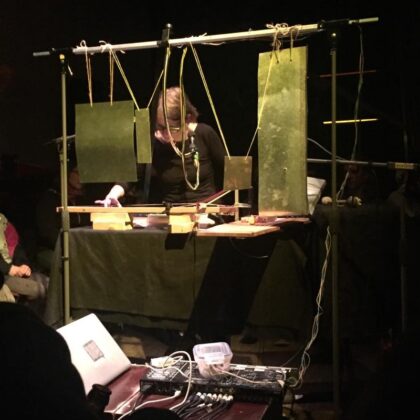
The Berlin edition is dedicated to the intersections of experimental music, improvisation, and innovative instrument building. It serves as a transatlantic platform for artistic innovation, bringing together Brazil’s creative Gambiarra culture and Berlin’s Echtzeitmusik scene. At its core lies the legacy of guitarist and instrument builder Hans Reichel, whose work understood the instrument not merely as a tool for sound production, but as an extension of body, perception, and imagination. This perspective is reflected in three afternoon showcases by Paulo Hartmann, sound artist and composer-performer Annette Krebs, and daxophone expert Kriton Beyer, as well as in a panel discussion, followed by two duo performances and a quartet performance, also featuring Emilio Gordoa on vibraphone.
The program additionally explores the potential of network technologies as a medium for contemporary improvisation. If Hans Reichel’s legacy lives on in the wood and wire of hand-built instruments, Ethernet Orchestra carries the same spirit of invention into the digital realm through tele-improvised music. Founded by trumpeter, composer, and improviser Roger Mills, the ensemble emerged from a research project connecting geographically distributed musicians and sound artists across cultures. The Berlin performance features stick player and Soundjack software inventor Alexander Carôt, joined on stage by Ethernet Orchestra bassist Paulo Hartmann and Luam Clarindo, performing on his extended cuíca, a hand-built instrument based on the legendary Brazilian voice of Samba School carnival parades. Further members of the networked ensemble are Magdalena Chudy, Fábio Furlanete, Wesley Ribeiro, Chris Vine, and Joy Yang.
Program
16:00–16:15 Paulo Hartmann & Mathias Maschat: Welcome and Introduction
16:15–16:45 Showcase I – Brazilian Luthiery
Paulo Hartmann: Gambiarra Aesthetics and Instrument Building
16:45–17:15 Showcase II: German Luthiery
Annette Krebs: The ‘Konstruktion#’ Series as a Sound Laboratory, a Space for Experimentation and a Basis for Real-Time Compositions and Improvisation
17:15–17:30 break
17:30–18:30 Showcase III:
Kriton Beyer: The Daxophone – Exploring the Creative Bond between Maker, Material and Sound
18:30–19:00 Round Table: The Legacy of Hans Reichel
Kriton Beyer, Paulo Hartmann & Mathias Maschat
19:00–20:00 Networking Break & Bar
20:00–20:45 Ethernet Orchestra feat. Alex Carôt (+ Introduction by Alex Carôt)
20:45–21:00 break
21:00 Kriton Beyer | Emilio Gordoa | Paulo Hartmann | Annette Krebs
Annette Krebs / Emilio Gordoa Duo
Kriton Beyer / Paulo Hartmann Duo
Beyer / Gordoa / Hartmann / Krebs Quartet
Artist Bios
Paulo Hartmann is a Brazilian transdisciplinary artist, musician, and curator whose work spans prepared guitar, sound art, teleperformance, and real-time improvisation. A pioneer of the prepared guitar in Brazil, he has presented performances internationally while collaborating with artists across music and the visual arts. As co-founder of Orquestra Descarrego, member of the Ethernet Orchestra, and co-curator of Improfest, he brings together artistic experimentation, technological innovation, and international exchange.
Kriton Beyer is a Greek-German composer and improviser best known for his distinctive work with the harmonium and the daxophone. Based in Berlin since 2004, he has developed an individual instrumental language through preparations, found objects, extended playing techniques, and subtle electronics, while collaborating widely across experimental music, dance, and visual art. He is the founder of Fragmentation Orchestra, a member of the electroacoustic trio uproot, and curator of The Procrustean Bed, a Berlin concert series and record label dedicated to experimental and improvised music.
Emilio Gordoa is a Mexican sound artist, percussionist, curator, and composer based in Berlin whose work explores sound and performance through solo, ensemble, and interdisciplinary projects. Active in Berlin’s Echtzeitmusik scene as well as the international experimental music community, he combines extended percussion techniques with electronics in performances, installations, and compositions. Alongside his artistic practice, he founded the experimental music platform WildSonico and the Mexican festival FILEC (Festival Internacional de Libre Expresión de Cuernavaca).
Annette Krebs is a Berlin-based sound artist and composer-performer who develops highly amplified instrumental assemblages of metal, strings, objects, and microphones. Her Konstruktion series combines analogue and digital techniques to reveal subtle sonic textures that remain inaudible in conventional instrumental settings. She performs internationally, has released numerous recordings, and also teaches and supports projects involving live electronics and interactive technologies.
Alexander Carôt is Professor of Media Computer Science and Dean of the Department of Computer Science and Languages at Anhalt University of Applied Sciences. Since 2005, he has developed the network music software Soundjack, combining artistic practice and engineering research to advance low-latency performance across distance. As a Stick player and researcher, his work focuses on telematic music performance and new transmission technologies for distributed ensembles.
Ethernet Orchestra
Magdalena Chudy is a researcher, music technologist, computer scientist, and cellist based in Warsaw. Her work investigates the relationship between instrumental gesture, timbre, and performance, while combining live cello playing with sound processing and improvisation. Alongside her academic research, she has been a member of the Female Laptop Orchestra since 2014 and performs in experimental music contexts.
Luam Clarindo is a Brazilian percussionist, researcher, and educator whose work explores the relationship between free improvisation, live electronics, and movement. He is the musical curator of the Improviso Dança e Música project, founder of Projeto Netuno, and currently pursuing doctoral research on percussion improvisation with live electronics. His artistic practice combines performance, research, and experimental instrument development.
Fábio Furlanete is a Brazilian saxophonist, composer, researcher, and professor at the State University of Londrina. His artistic and academic work focuses on free improvisation, aesthetics, and questions of authorship and power in musical practice. He is Director of the Collective for Contemporary Free Improvisation (CLIC) and has performed in remote improvisation projects with the Ethernet Orchestra.
Chris Vine is a guitarist, composer, and sound designer whose work has ranged from the improvised music scenes of New York and Washington, D.C., to collaborations in film, dance, and theatre. Since the 1980s he has developed an individual improvisational language through work in Europe and the Americas, including with the cult band Blurt. He currently performs with the duo Barsa and Briggy and is a member of the Ethernet Orchestra.
Joy Yang is a performing artist whose practice brings together piano, theremin, electronics, free improvisation, and interdisciplinary performance. Drawing on influences from classical music, jazz, and experimental practice, she creates works that connect music with visual art, movement, and STEAM-based approaches. Her performances are shaped by an interest in identity, collaboration, and cross-disciplinary artistic processes.