“Sounds are beings. They are born, spend a distinct life span at particular places and then die. They love to form social organisms.” (Thomas Gerwin)
The composer, sound artist and improviser Thomas Gerwin has for many years been one of the defining voices of an expanded sound art that takes listening itself as its subject. His work is deeply connected to acoustic ecology and the soundscape movement around R. Murray Schafer. In his practice, he combines composition, improvisation and spatial staging to create complex experiential environments in which sound is not only heard, but experienced physically and situationally.
In conversation with Mathias Maschat, the focus is on different forms of listening beyond the traditional concert setting: What possibilities exist today for perceiving sound? How do modes of listening change through space, movement or interaction? And how can sensory dimensions such as touch or spatial orientation be integrated into artistic sound concepts? A particular emphasis lies on multisensory listening – the inclusion of additional senses such as touch, taste or smell in a contemporary, nuanced perception of sound. Thomas Gerwin has for years developed formats such as soundwalks, spatial concerts and walk-in loudspeaker environments that make these questions tangible.
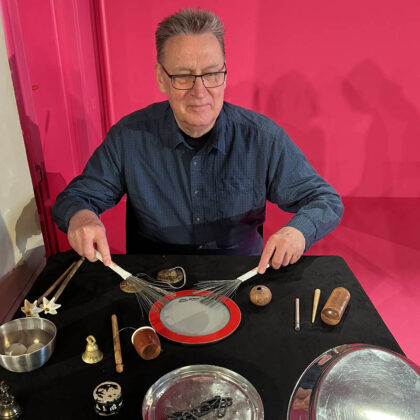
In the subsequent sound performance, a multi-layered live composition unfolds: starting from improvised sounds on objects he has brought along, Thomas Gerwin creates a recording that immediately becomes the point of departure for a second movement. As it is played back, he expands the sonic space performatively into the entire room – using everyday materials such as radiators, windows, chairs or doors, extending even into adjacent areas. In this way, an interplay emerges between recording and live action, between proximity and distance, between focused listening and spatial experience.
Born in 1955 in Kassel, Thomas Gerwin studied musicology, linguistics and composition, and early on turned to electroacoustic music, improvisation and radiophonic sound art. Since 1990, he has worked intensively in the field of soundscape composition. At his Berlin studio inter art project, he creates works for concert, performance, radio and installation, often conceived in an interdisciplinary way and incorporating media such as theatre, film, light or sculpture. He is the founder and artistic director of numerous ensembles and initiatives, including the International Sound Art Festival Berlin, and has played a significant role in shaping the contemporary music and sound art scene in various capacities. His works have been performed, broadcast and awarded internationally.